
Ivan Ambrocio
There’s been a lot of discussion lately around exact match domains and partial match domains, so I wanted to test the theory for myself.
Instead of looking at case studies or relying on what other SEOs were saying, I decided to buy an exact match domain targeting a bottom-of-the-funnel keyword and see what happened.
The goal was simple:
Could I buy an exact match domain, launch a new website, rank it for the target keyword, and eventually get the site cited inside Google AI Overviews?
The Exact Match Domain Experiment
For this test, I targeted the keyword “tree removal Yuba City.”
This is a bottom-of-the-funnel local keyword. Someone searching for it is probably not researching what tree removal is. They are looking for a company that can remove a tree in Yuba City.
I purchased an exact match domain around that search and built a website specifically around tree removal and related tree services in the area.
Then I started tracking how Google treated the new site.
What I Did to the Website
One of the things I wanted to test was whether the site could gain visibility without doing a large link-building campaign.
I did very little off-page SEO.
Most of the work consisted of:
- Building the website around the target service and location
- Creating basic foundational links and business profiles
- Writing the initial content with AI and human editing
- Expanding pages with additional useful content
- Creating supporting pages around related tree services
- Improving the website as Google began crawling and indexing it
I did not spend months actively building backlinks to the domain.
The Results After About Two Months
After roughly two months, the website started ranking for “tree removal Yuba City.”
It was initially near the bottom of the search results, but the important part of the experiment was that Google was willing to rank a brand-new website for the exact keyword the domain was targeting.
The site also started appearing as a source within Google AI Overviews.
Here are screenshots showing the Search Console data and AI Overview visibility from the experiment.
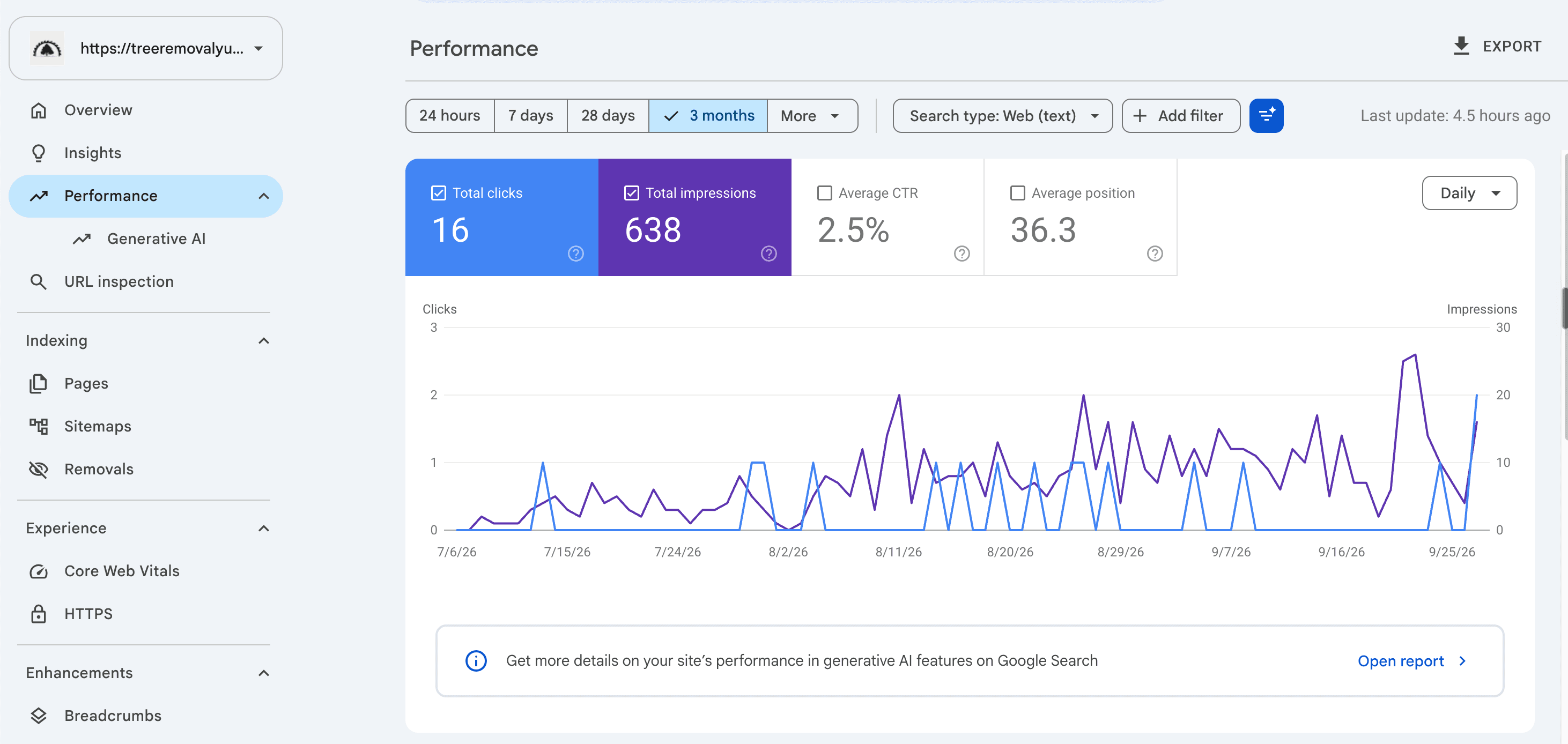
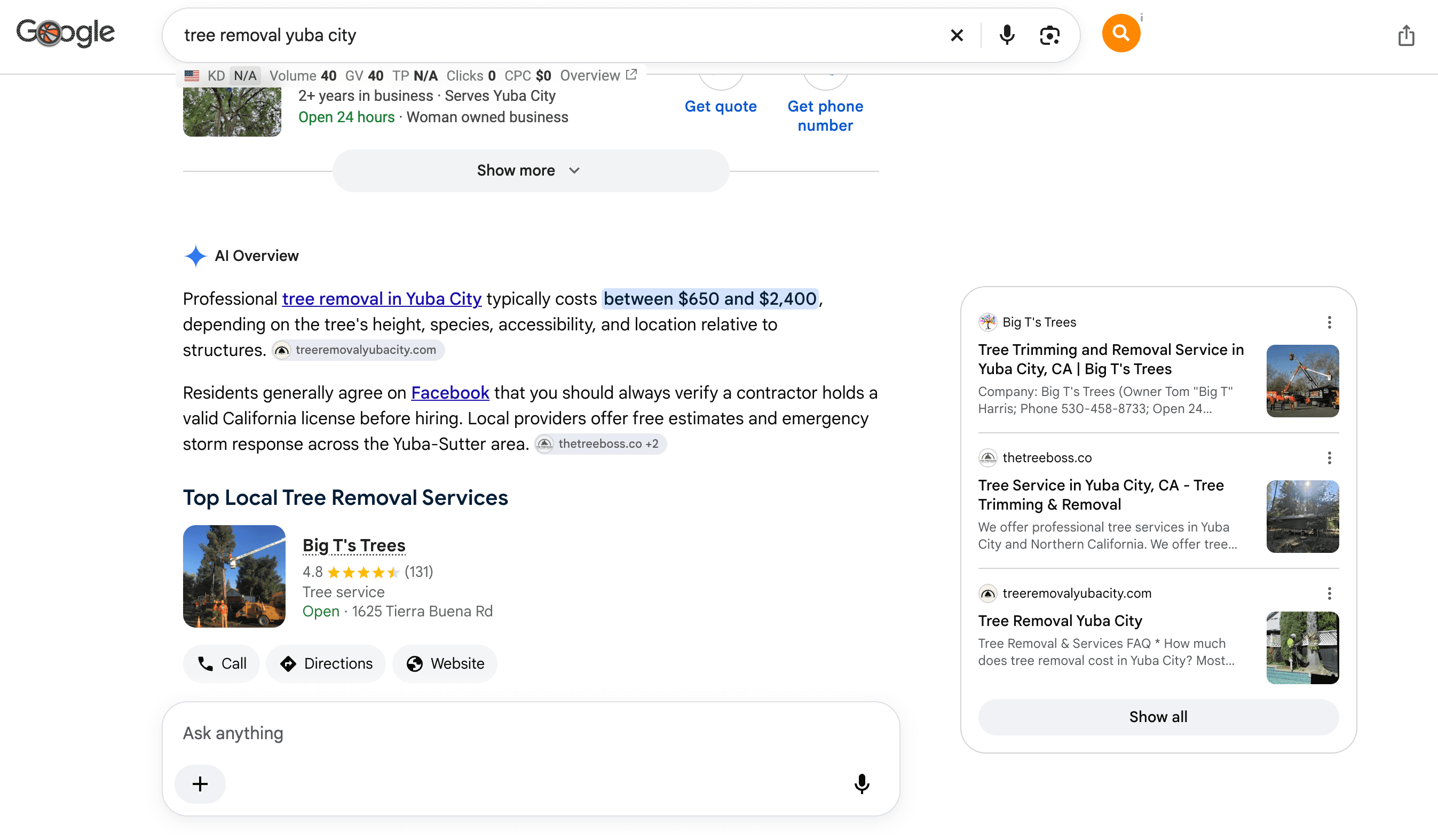
That was especially interesting because the domain had very little authority and almost no intentional link building behind it.
Does This Mean Exact Match Domains Automatically Rank?
No.
The takeaway from this experiment is not that you can buy an exact match domain, publish a few AI-generated pages, and immediately rank.
There are still a lot of factors involved.
The website had content specifically written around the service and location, supporting pages, internal linking, proper site structure, and enough information for Google to understand exactly what the website was about.
The exact match domain may have helped reinforce that relevance, but I would not attribute the rankings entirely to the domain name.
That is exactly why I want to continue testing it.
Testing More Exact Match Domains
Since running this experiment, I’ve purchased several more exact match domains.
I’m now building websites around different local and bottom-of-the-funnel keywords to see whether the results can be replicated.
I want to test things like:
- How quickly new exact match domains get indexed
- How long it takes them to reach page one
- Whether exact match domains perform differently from branded domains
- How much content is required
- How important backlinks are
- Whether they consistently appear in Google AI Overviews
- How Google treats exact match domains across different industries and cities
One successful website is interesting.
Several websites following similar patterns would give us much better data.
Google AI Overviews vs. ChatGPT
Another interesting part of the experiment is that the website can appear in Google AI Overviews while still not appearing when I ask ChatGPT for tree removal companies in Yuba City.
That shows why ranking in traditional Google Search, Google AI Overviews, and AI assistants should not necessarily be treated as the same thing.
Different platforms can rely on different search indexes, sources, ranking systems, and retrieval methods.
For this experiment, I’m going to continue tracking the website across Google Search, Google AI Overviews, Bing, ChatGPT, and other AI search tools to see when and where the domain begins appearing.
What I’m Testing Next
The bigger question is not whether one exact match domain can rank.
It is whether this strategy can be repeated.
Over the next several months, I’ll be testing more exact match and partial match domains, documenting what works, what fails, how quickly each site gains visibility, and whether those sites begin appearing across traditional search and AI search.
The goal is to build enough of these experiments that we can start separating SEO theories from patterns that can actually be reproduced.